How to Promote an Online 50/50 Raffle: The Complete Marketing Guide for Nonprofits
Learn how to promote an online 50/50 raffle with proven nonprofit marketing strategies. Discover email campaigns, social media, QR codes, community partnerships, and practical tips to sell more raffle tickets and maximize fundraising success.
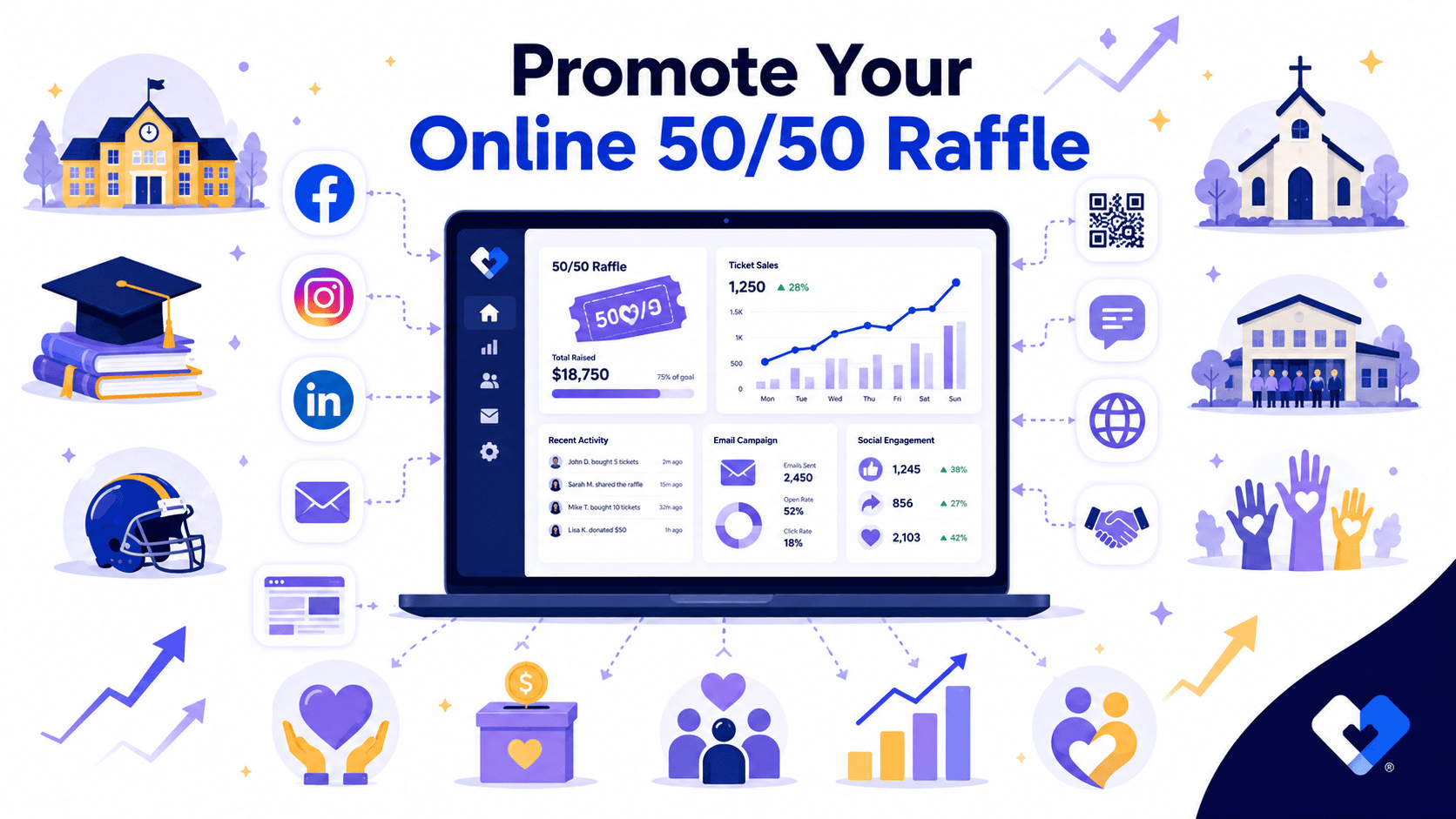
Running an online 50/50 raffle has never been easier. Running a successful online 50/50 raffle, however, requires much more than choosing a prize and publishing a campaign page. Every year, nonprofit organizations invest significant time organizing raffles only to see ticket sales fall short of expectations. After the drawing is complete, many assume the raffle itself was the problem, when the real issue was often a lack of strategic marketing.
An online 50/50 raffle is more than a fundraising event. It is a marketing campaign with a fundraising outcome. Organizations that consistently generate strong results understand this distinction. They begin building awareness well before ticket sales open, communicate their mission consistently, equip volunteers with marketing resources, and make it easy for supporters to share the campaign with others.
By contrast, many organizations wait until launch day to begin promotion. They publish a few social media posts, send one or two emails, and hope the campaign gains momentum on its own. While enthusiasm is important, successful fundraising depends on a structured marketing plan rather than good intentions.
This guide was created to help nonprofit leaders build that plan. Whether your organization is preparing for its first online 50/50 raffle or looking to improve existing fundraising efforts, the strategies in this guide will help you increase awareness, expand your audience, and generate stronger ticket sales from launch through the final drawing.
Why Great Raffles Fail
When nonprofit leaders review the results of a fundraising campaign, they often focus on questions such as whether the prize was attractive enough, whether ticket prices were appropriate, or whether the campaign launched at the right time. While each of these factors can influence participation, they rarely determine the overall success of a raffle.
The more important question is whether enough people knew the raffle existed in the first place. Even the most exciting prize cannot generate ticket sales if potential supporters never hear about it. A well-promoted raffle with a modest prize will often outperform an exceptional raffle that receives very little exposure. Marketing is not an activity that happens after a raffle is created. It is one of the primary drivers of fundraising success and should receive the same level of planning as the raffle itself.
Marketing Begins Before Ticket Sales Open
One of the most common mistakes nonprofits make is treating launch day as the beginning of their marketing campaign. In reality, successful promotion starts weeks before the first ticket becomes available. Think about how major organizations introduce new products, movies, or sporting events. They build anticipation long before asking people to buy. The same principle applies to nonprofit fundraising. By the time ticket sales begin, supporters should already know that something exciting is coming and understand why it matters.
Creating anticipation before launch gives organizations valuable momentum. Instead of starting from zero on opening day, they begin with an audience that is already aware of the campaign and prepared to participate.
The Four Phases of a Successful Raffle Marketing Campaign
Rather than viewing promotion as one continuous activity, it is helpful to think of a raffle campaign as four distinct phases. Each phase has its own purpose and requires a different communication strategy.
Campaign Phase | Primary Goal |
Pre-Launch | Build awareness and anticipation before tickets become available. |
Launch | Generate immediate excitement and encourage early ticket sales. |
Growth | Keep the campaign visible while encouraging supporters to share it with their own networks. |
Final Countdown | Create urgency and maximize participation before the drawing closes. |
Breaking a campaign into phases helps organizations avoid repeating the same message throughout the fundraiser. Instead, each stage introduces new reasons for supporters to engage, keeping the campaign fresh and maintaining momentum over several weeks.
Think Beyond Social Media
Many organizations believe they have a marketing strategy because they plan to post on Facebook or Instagram. Social media is certainly an important communication channel, but it is only one piece of a successful promotional plan.
Most supporters interact with a campaign multiple times before purchasing tickets. They might first learn about the raffle through an email newsletter, later see a social media post, notice a QR code at an event, receive a text message reminder, and finally decide to participate after visiting the organization's website. Each interaction reinforces the previous one, building familiarity and confidence.
Effective marketing combines multiple channels that work together to create repeated exposure. The goal is not simply to publish more content but to deliver consistent messages wherever supporters are most likely to engage.
Expand Your Audience Beyond Existing Donors
One of the greatest advantages of an online 50/50 raffle is its ability to reach people outside an organization's traditional donor base. Existing supporters remain incredibly valuable, but every supporter also has friends, family members, coworkers, neighbors, and social connections who may be willing to participate if they are introduced to the campaign.
Parents can share with grandparents. Volunteers can invite coworkers. Board members can reach professional contacts. Alumni can reconnect with classmates. Local businesses can introduce the fundraiser to their customers. Successful organizations recognize that every supporter represents an opportunity to reach an entirely new audience. Instead of measuring success by how many tickets each donor purchases, they encourage supporters to become ambassadors who help expand the campaign's reach.
Understand Who You Are Talking To
Not every supporter participates for the same reason, which is why effective marketing begins with understanding your audience. A parent may purchase tickets because they want to support their child's school, while an alumnus may participate out of loyalty to an organization that shaped their life. A local business owner may see the raffle as an opportunity to invest in the community, while a long-time donor simply wants to help advance the nonprofit's mission.
Identifying these different motivations allows organizations to tailor their messaging more effectively.
Audience | Primary Motivation |
Existing Donors | Supporting the organization's mission and long-term impact. |
Parents | Helping programs their children participate in. |
Alumni | Giving back to an organization that influenced their lives. |
Volunteers | Supporting causes they already care about. |
Local Businesses | Demonstrating community involvement and goodwill. |
Community Members | Supporting local organizations while participating in an exciting fundraiser. |
Board Members | Helping the organization achieve important fundraising goals. |
The prize may capture attention, but the mission is what inspires participation. Organizations that consistently communicate both tend to generate stronger engagement than those focused solely on the cash prize.
Build a Campaign Around Your Mission
The most memorable fundraising campaigns do not simply ask supporters to buy tickets. They explain what those ticket purchases make possible.
Instead of saying, "Buy tickets for our raffle," explain that every ticket helps send the robotics team to a national competition, purchase new instruments for the school band, fund scholarships for local students, or provide meals for families in need. The raffle becomes the fundraising vehicle, while the mission becomes the reason people choose to participate.
Every marketing message should answer a simple question: What positive impact will this ticket purchase create? When supporters clearly understand that answer, they are far more likely to participate and encourage others to do the same.
Prepare Before You Launch
Many organizations spend the first week of a raffle creating marketing materials instead of promoting the campaign. Preparing these assets before launch allows the team to focus entirely on communication once ticket sales begin.
Marketing Asset | Purpose |
Campaign landing page | Serves as the central destination for all supporters. |
Feature graphic | Creates a consistent visual identity across marketing channels. |
Email templates | Speeds communication throughout the campaign. |
Social media graphics | Ensures consistent messaging across platforms. |
QR code | Makes it easy for supporters to access the raffle from printed materials and events. |
Short campaign URL | Simplifies sharing during presentations and conversations. |
Frequently Asked Questions | Reduces confusion and increases confidence. |
Volunteer marketing toolkit | Equips advocates to promote the campaign consistently. |
Investing time in preparation pays dividends throughout the campaign. Rather than constantly creating new content, organizations can focus on building relationships, responding to supporters, and maintaining momentum.
Momentum Is Built Through Consistency
Successful raffle marketing is rarely the result of one exceptional email or one viral social media post. It is the result of consistent communication over time.
Supporters are busy, and many will not purchase tickets the first time they hear about a campaign. Some need multiple reminders, while others wait until the final days before making a decision. Consistent communication keeps the fundraiser visible without overwhelming the audience.
The organizations that raise the most money are not always those with the largest marketing budgets. More often, they are the organizations that communicate clearly, consistently, and purposefully throughout every stage of the campaign.
In the next section, we will build a complete promotional system, including a week-by-week marketing timeline, email strategy, social media calendar, QR code implementation, text messaging, local business partnerships, community outreach, and proven techniques for increasing online 50/50 raffle ticket sales.
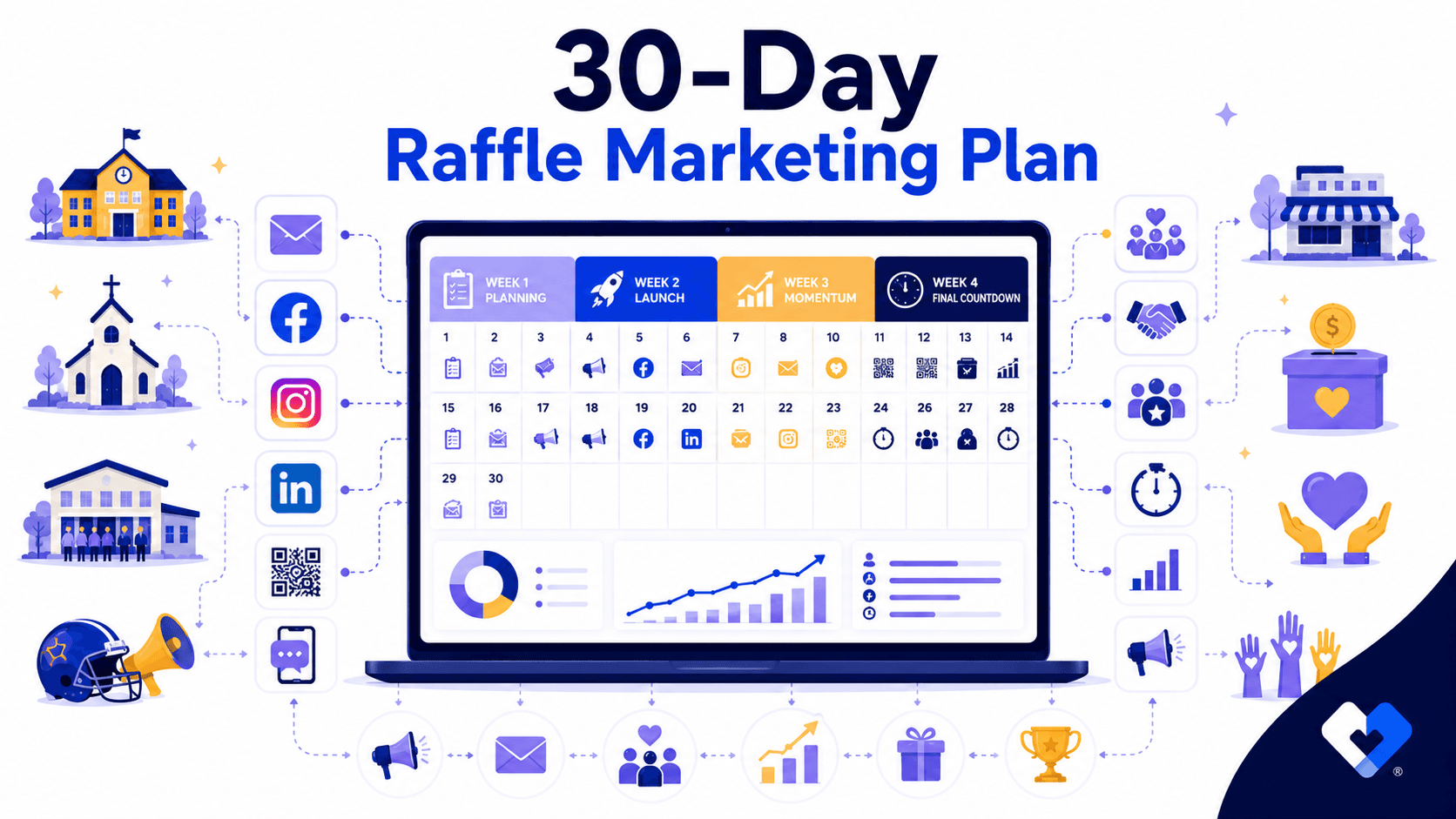
Build Your Promotional Timeline Before You Launch
One of the biggest advantages successful nonprofit organizations have over struggling campaigns is preparation. By the time ticket sales open, the strongest organizations already know what they will communicate each week, which audiences they will target, and which marketing channels they will use. Without a promotional timeline, marketing often becomes reactive. Volunteers scramble to create social media posts, emails are sent only when someone remembers, and supporters hear about the raffle inconsistently. The result is a campaign that never develops momentum.
A written marketing calendar solves this problem. It allows your team to focus on engaging supporters instead of constantly deciding what to do next.
The timeline below provides a proven framework that organizations of nearly every size can adapt to fit their fundraising goals.
Timeline | Primary Objective | Recommended Activities |
3 to 4 weeks before launch | Build anticipation | Announce the upcoming raffle, recruit ambassadors, prepare marketing assets, and begin teasing the campaign. |
Launch week | Generate excitement | Publish the campaign, send launch emails, announce across social media, activate board members and volunteers, and encourage immediate ticket purchases. |
Mid-campaign | Maintain momentum | Share progress updates, spotlight your mission, highlight supporters, and encourage community sharing. |
Final week | Create urgency | Increase communication frequency, emphasize the approaching drawing date, and remind supporters that time is running out. |
Drawing day | Celebrate participation | Announce the winner, thank supporters, share fundraising results, and invite participants to stay involved. |
While every organization's schedule will differ, the principle remains the same. A campaign should continually evolve instead of repeating the same message for several weeks.
Four Weeks Before Launch: Build Anticipation
Many nonprofits underestimate the value of anticipation. They focus all of their attention on launch day, when in reality the weeks before launch are often the most important part of the campaign.
This is the time to explain why the fundraiser matters, introduce the cause it supports, and begin creating excitement within your community.
Rather than asking supporters to purchase tickets immediately, focus on telling your organization's story. Share photographs of the students who will benefit, introduce the youth sports team raising funds for new equipment, explain how proceeds will support scholarships, or highlight the community programs made possible through donor participation.
People connect with stories long before they connect with transactions. During this stage, your team should also prepare every marketing asset needed for the campaign. Email templates, social graphics, QR codes, campaign videos, website banners, and volunteer toolkits should all be completed before launch day arrives.
Launch Week: Generate Early Momentum
The first several days of a raffle campaign often determine its long-term success.
Early ticket sales create social proof. When supporters see that others are already participating, they become more confident joining themselves. An active campaign also generates excitement among volunteers, board members, and community partners. Launch week should be coordinated across every communication channel available to the organization.
Your website should feature the raffle prominently on the homepage. Email subscribers should receive an announcement explaining both the prize and the mission behind the fundraiser. Social media platforms should introduce the campaign using compelling visuals and clear calls to action. Board members and volunteers should be encouraged to share the campaign through their personal networks rather than relying solely on the organization's official accounts. The goal during launch week is simple: create enough visibility that supporters begin talking about the raffle themselves.
Email Marketing Remains One of Your Most Valuable Tools
Despite the growth of social media, email continues to deliver some of the highest returns for nonprofit fundraising. Unlike social platforms, where algorithms determine who sees your content, email allows organizations to communicate directly with supporters who have already expressed interest in their mission.
Rather than sending one generic email, develop a sequence that guides supporters through the campaign.
Campaign Stage | Email Focus |
Pre-launch | Announce the upcoming raffle and explain what it will support. |
Launch Day | Introduce the raffle, explain how to participate, and encourage immediate action. |
Mid-Campaign | Share fundraising progress, tell impact stories, and remind supporters that the campaign is still active. |
Final Week | Create urgency by emphasizing the approaching drawing date. |
After the Drawing | Thank supporters, announce results, and demonstrate the impact of the fundraiser. |
Every email should focus on the organization's mission first and the raffle second. Supporters are ultimately investing in your cause, not simply purchasing a chance to win a prize.
Use Social Media to Tell a Story
Many nonprofit organizations treat social media like a bulletin board. They post the same promotional graphic repeatedly with slightly different captions, hoping that more exposure will lead to more ticket sales.
A better approach is to think like a storyteller.
Throughout the campaign, share different aspects of your organization's mission. Introduce the people who benefit from the fundraiser. Highlight volunteers. Celebrate sponsors. Show preparations for the drawing. Share updates as milestones are reached. Each post should give supporters a new reason to engage rather than repeating the same message over and over again.
Variety keeps the campaign interesting while reinforcing why participation matters.
Make Sharing Effortless
One of the greatest advantages of digital fundraising is that every supporter can become a marketer. That only happens, however, if sharing is simple.
Every campaign should include direct social sharing options, QR codes, short URLs, and graphics sized for different platforms. Volunteers should never have to design their own promotional materials or write their own messaging from scratch. Providing ready-to-use marketing assets dramatically increases the likelihood that supporters will actively promote the campaign within their own networks.
Remember that every supporter represents dozens or even hundreds of additional potential participants. The easier it is to share, the farther your campaign can reach.
Strengthen Your Campaign Through Your Website
Your website remains one of the few digital properties your organization completely controls. Unlike social media platforms, where algorithms determine visibility, your website allows you to present the raffle exactly as you intend. The campaign should be easy to find from the homepage, clearly explain its purpose, answer common questions, and provide a straightforward path to ticket purchases.
Many organizations also benefit from creating supporting content during the campaign. Blog articles, impact stories, sponsor spotlights, and volunteer interviews all help keep the raffle visible while improving search engine visibility. Over time, these additional pages contribute to both fundraising and long-term SEO performance.
QR Codes Connect the Physical and Digital Worlds
QR codes have become one of the simplest ways to bridge in-person events with online fundraising. Whether displayed on posters, table tents, event signage, printed programs, business counters, or volunteer handouts, a QR code allows supporters to move directly from a physical interaction to your raffle page within seconds.
The key is placement.
QR codes should appear anywhere supporters naturally pause, including registration tables, concession stands, reception areas, information booths, sponsor locations, and community bulletin boards. When paired with a short explanation of the organization's mission, QR codes become a highly effective fundraising tool that requires very little ongoing maintenance.
In the next section, we will explore advanced promotional strategies, including text messaging campaigns, partnerships with local businesses, media outreach, community ambassadors, campaign optimization, measuring marketing performance, and the techniques that consistently produce the strongest ticket sales during the final days before the drawing.
Advanced Strategies That Help Sell More Raffle Tickets
Once a campaign is underway, many organizations settle into a routine of sending occasional emails and posting on social media. While consistency is important, the strongest fundraising campaigns continue looking for new opportunities to reach supporters throughout the life of the raffle. The most successful organizations recognize that every interaction with the community represents another opportunity to introduce someone to the fundraiser. They actively look for ways to expand awareness rather than relying solely on the marketing channels they already control.
Partner with Local Businesses
Community businesses are often looking for meaningful ways to support local nonprofits while increasing their own visibility. A raffle campaign creates a natural partnership that benefits both organizations.
Restaurants, coffee shops, fitness centers, retail stores, professional offices, and community gathering places may be willing to display posters, distribute QR codes, include information in customer newsletters, or mention the fundraiser on their own social media channels. The partnership should always emphasize the shared community impact rather than simply asking the business to advertise the raffle. When local businesses understand how the fundraiser benefits schools, youth organizations, veterans, or families in need, they are often eager to participate.
Use Text Messaging Thoughtfully
Text messaging has become one of the most effective communication tools available to nonprofits. Because text messages are typically read within minutes, they can be especially valuable during the launch of a campaign and the final days before the drawing. Messages should remain concise and purposeful. Rather than sending frequent reminders, focus on moments when supporters genuinely need new information, such as announcing that ticket sales are now open, celebrating an important fundraising milestone, or reminding participants that the drawing closes soon.
Like every other communication channel, text messaging should reinforce your broader campaign rather than replace it.
Encourage Volunteers to Become Ambassadors
Volunteers are among the most powerful marketing resources any nonprofit possesses. They already believe in the organization's mission and often have extensive personal and professional networks. Instead of simply asking volunteers to "share the raffle," provide them with everything they need to succeed. Give them prewritten social media posts, email templates, QR codes, printable flyers, and campaign graphics. The easier it is for volunteers to promote the fundraiser, the more consistently your message will reach new audiences.
One enthusiastic volunteer can introduce the campaign to hundreds of potential supporters. Multiply that across an entire volunteer team, and the impact can be substantial.
Keep the Campaign Fresh
Supporters should feel that the campaign is evolving rather than repeating itself. Throughout the raffle, share different types of content that reinforce your mission while giving people new reasons to engage.
Content Type | Purpose |
Mission stories | Demonstrate the impact of every ticket purchased. |
Volunteer spotlights | Recognize the people making the fundraiser possible. |
Sponsor recognition | Thank community partners and encourage additional participation. |
Progress updates | Build excitement as fundraising milestones are reached. |
Behind-the-scenes content | Help supporters feel connected to the organization. |
Drawing preparation | Increase anticipation as the campaign approaches its conclusion. |
This variety keeps supporters interested while continually reinforcing why the fundraiser matters.
The Final 72 Hours
The final days of a raffle often produce the highest volume of ticket sales.
Supporters who intended to participate but postponed their purchase now face a clear deadline. This natural sense of urgency should be reflected in your communication strategy.
Increase the frequency of updates during the final seventy-two hours while maintaining a helpful and mission-focused tone. Remind supporters of the drawing date, celebrate fundraising progress, and clearly explain how every additional ticket helps advance the organization's mission.
Urgency should never feel artificial. Simply highlighting the approaching deadline is usually enough to encourage action.
Measure Every Campaign
One of the greatest advantages of digital fundraising is the ability to learn from every campaign. Rather than evaluating success solely by the total amount raised, organizations should review the marketing activities that contributed to those results. Questions worth asking include:
Evaluation Question | Why It Matters |
Which marketing channels generated the most traffic? | Helps prioritize future marketing efforts. |
Which emails produced the highest engagement? | Improves future communication strategies. |
Which social media posts generated the most sharing? | Identifies the content supporters value most. |
When were the highest ticket sales recorded? | Reveals opportunities to improve campaign timing. |
Which partners generated the most referrals? | Strengthens future community partnerships. |
Over time, these insights allow organizations to refine their approach and consistently improve fundraising performance.
Common Marketing Mistakes to Avoid
Even experienced nonprofit organizations occasionally fall into predictable marketing traps. Fortunately, most are easy to avoid with thoughtful planning.
The first mistake is treating marketing as something that begins after the raffle launches. Successful campaigns are already building awareness weeks before ticket sales open. Another common mistake is focusing exclusively on the prize instead of the mission. While the prize attracts attention, the mission is what motivates long-term support and encourages people to share the campaign with others.
Organizations also underestimate the importance of consistency. One excellent email or one successful social media post rarely produces exceptional fundraising results. Strong campaigns are built through regular, coordinated communication across multiple channels.
Finally, many nonprofits fail to evaluate their campaigns after they conclude. Every raffle generates valuable information that can make the next fundraiser even more successful.
Frequently Asked Questions
How early should we begin promoting an online 50/50 raffle?
Most organizations benefit from beginning promotional activities three to four weeks before ticket sales open. This allows enough time to build awareness, prepare marketing assets, and generate anticipation before launch.
How often should we send fundraising emails?
A planned sequence generally performs better than frequent, unstructured messages. Many successful campaigns include a pre-launch announcement, a launch email, one or two progress updates, a reminder during the final week, and a thank-you message after the drawing.
Which social media platform works best?
There is no single best platform. Organizations should focus on the channels where their supporters are already active. Facebook often performs well for community fundraising, while Instagram, LinkedIn, and emerging platforms may be appropriate depending on the audience.
Should we use paid advertising?
Paid advertising can complement an existing campaign, but it should not replace strong organic marketing. Organizations should first maximize their email lists, volunteer networks, community partnerships, and social media before investing in advertising.
How important are QR codes?
QR codes are one of the simplest ways to connect printed materials with digital fundraising. They work particularly well at community events, restaurants, athletic competitions, festivals, and sponsor locations.
How can we encourage supporters to share the raffle?
Make sharing effortless. Provide ready-made graphics, sample captions, QR codes, and short campaign links. The fewer steps supporters must take, the more likely they are to introduce the fundraiser to others.
What should we do after the drawing?
The fundraiser should not end when the winner is announced. Thank supporters promptly, celebrate the campaign's success, explain how funds will be used, and invite participants to remain connected with your organization. This follow-up communication helps convert one-time participants into long-term supporters.
Final Thoughts
Successful online 50/50 raffles are not built on luck. They are built on thoughtful planning, consistent communication, and a genuine commitment to sharing the organization's mission with the community. The prize may attract initial attention, but it is the mission that inspires people to participate, share the campaign, and continue supporting the organization long after the drawing has concluded.
By developing a structured promotional timeline, preparing marketing assets in advance, communicating through multiple channels, and continually measuring campaign performance, nonprofit organizations can transform a raffle into one of their most effective fundraising tools.
Every campaign also provides an opportunity to learn. The organizations that consistently improve their fundraising results are those that review each raffle, identify what worked well, refine what did not, and apply those lessons to future campaigns.
Continue Your Learning
Explore these additional RaffleGives resources to strengthen your fundraising strategy:
- School Raffle Platform
https://www.rafflegives.com/school-raffle-platform/ - Nonprofit Raffle Software
https://www.rafflegives.com/nonprofit-raffle-software/ - Online 50/50 Raffles
https://www.rafflegives.com/online-50-50-raffle/ - Raffle Laws by State
https://www.rafflegives.com/raffle-laws-by-state/ - Fundraising Success Guides
https://www.rafflegives.com/fundraising-success-guides/
About RaffleGives
RaffleGives helps qualified nonprofit organizations simplify raffle fundraising through modern, digital-first technology designed for charities, schools, PTAs, PTOs, booster clubs, churches, and community organizations.
If your organization is planning an online 50/50 raffle, we'd be happy to show you how RaffleGives can help you create a transparent, engaging fundraising experience that is easier to manage and easier for supporters to share.
Contact us to schedule a personalized demonstration and discover how RaffleGives can support your next fundraising campaign.
Follow RaffleGives for practical fundraising strategies, compliance updates, and nonprofit technology insights.
LinkedIn:
https://www.linkedin.com/company/raffle-gives/
Facebook: